New perspectives on a fast-changing world from JLL’s Future Vision program
26 June 2024
Insight
26 June 2024
The future of real estate
Categories:
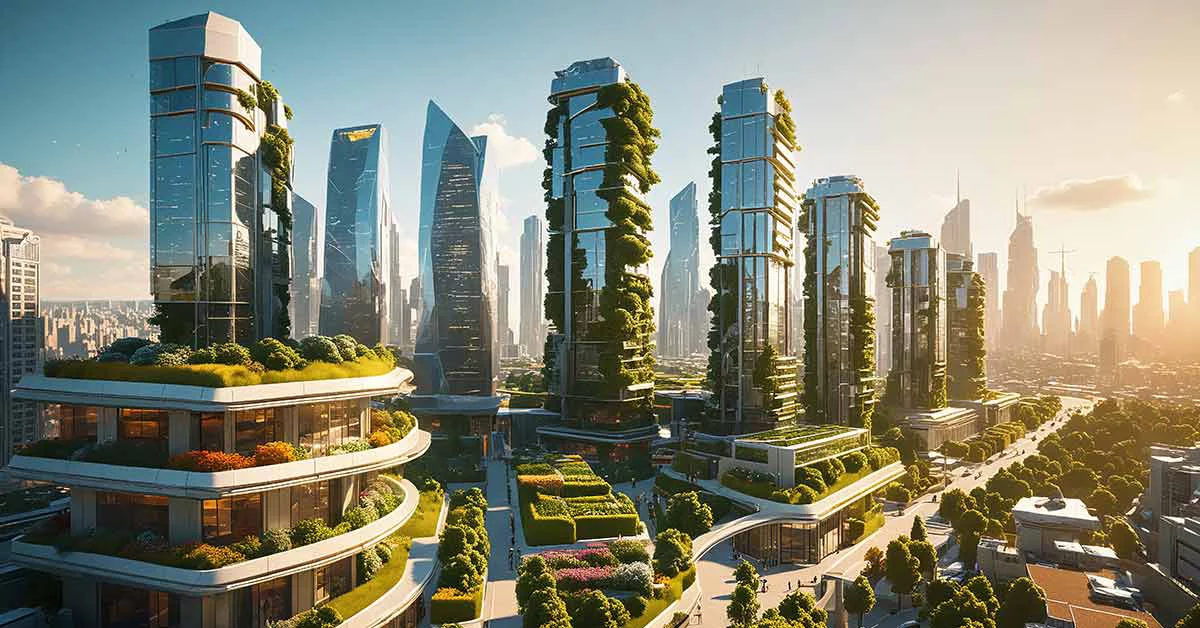
Image by bmf-foto.de - stock.adobe.com. This work product was created with assistance from generative AI.
Introducing JLL's Future vision program
What will our cities look like in the future? How will we keep up with all the rapid changes to how we live, work, invest and spend our free time? How will the built environment need to change to prepare for the different future scenarios that may lie ahead?
These are the broad questions being explored in the new JLL Future Vision program, an ambitious research initiative incorporating the perspectives of experts from a wide range of disciplines, from demography to anthropology and urban planning.
JLL Future Vision combines:
JLL’s robust, long-term exploration of megatrends: Our network of 500 researchers across the globe have sought to uncover what will matter most to the real estate industry in the coming years.
Thought-provoking input from a multi-disciplinary forum of future thinkers: We identify the meaningful signals that will shape our societies and the built environment.
Four imperatives to act on now
JLL’s researchers have explored over 80 scenarios that could impact our societies and economies in myriad ways. And it’s become clear there are four urgent priorities for commercial real estate: climate, people, technology and resilience.
“While no one knows what the future holds, we believe that exploring possible future scenarios enables the entire real estate value chain to prepare as much as possible for the unpredictable – and all the associated opportunities and risks, whatever they may be,” says Ben Breslau, JLL’s Chief Research Officer, who is leading the initiative.
The insights from the program are intended to help firms embrace the unknown and provide a roadmap for navigating ongoing change and disruption. Importantly, these actions can, and should, be taken today – from the ways we design, build and operate real estate, to how people and businesses interact with the built environment.
This article gives a snapshot of what JLL Future Vision has discovered so far. We’ll be sharing deeper insights in a series of further articles, starting with The Climate Inflection Point and Get set for the 5th Industrial Revolution.
Rather than attempting to predict the future, JLL Future Vision focuses on a scenario-based approach that enables planning for multiple futures.
What’s driving change?
Technology, climate change, demographic and societal shifts: there are few times in human history where so many major changes are colliding.
The built environment is often right at the center of it all. How buildings are designed, and where they are located, now need to factor in climate change. The ways people work – especially in the age of Artificial Intelligence – are reshaping how buildings are used. New technologies – from robotics to 3D printing – are poised to upend how spaces are built and maintained.
Occupiers and investors are preparing for what may come. But what exactly are these possible eventualities?
“Our purpose has not been to forecast what will happen, which can be a fruitless – indeed misleading – activity,” says Steven Lewis, JLL Global Head of Insight. “The focus instead is on a structured, scenario-based approach that enables planning for multiple futures by identifying what real estate companies must do now to capitalize on all eventualities and start pivoting as the future takes shape.”
Read on for a sample of what we discovered in relation to the four imperatives, and the questions business leaders need to be considering.
Technology imperative
Imagine a world where the implementation of AI, quantum computing, and robotics accelerates, enhancing efficiencies and empowering people to tackle previously insurmountable societal and scientific challenges. Real estate can expect to experience the impacts as both space provider and user of technology.
In this world, the built environment is set to become part of an interconnected ecosystem. But not everything will necessarily become digital. To the contrary, real-life experiences will become more important to people, with physical spaces taking on new meaning as they blend with technology, ranging from subtle step changes to fully-immersive realities.
The way the real estate industry operates will also change. Buildings and spaces will be constructed through advanced automation, with robotics and intelligent materials combining with new advanced 3D printing and modular construction capabilities. Digital twins will be embedded naturally in building processes, monitoring every aspect of a building’s life cycle, from design to demolition. Flexible spaces will be able to dynamically respond to any number of current needs.
Key questions for investors/occupiers
- How will technological advancement impact the markets that companies operate in this new landscape?
- What will new business models look like for developing, designing, operating, managing, leasing and investing in real estate?
- How will physical space need to change to make the best of new real estate technology and support people’s needs?
- How will we adapt to the high-capacity infrastructure requirements of the AI sector? What could be the impact on physical space, design, location strategies and property values?
People imperative
The way people live and work has seen dramatic upheaval in recent years. It’s not over, and it will continue to influence the real estate industry.
Imagine a world where employees in the majority of industries have a greater say regarding when and where they work. AI and advances in robotics impact the type and amount of work that people do. New technologies support increased recreation time, a gamechanger for cities, especially as life expectancy rises.
Companies and governments will have to put a growing emphasis on social impact, which will be set to play a much bigger role on real estate strategies. We’ll see this playing out in new hybrid workspaces acting as multi-functional, mixed-use environments that incorporate wellness, hospitality, and entertainment. Partnerships between governments and the private sector will encourage more services and spaces that foster community engagement and address equitable access. Housing affordability will become more acute in major cities; the real estate industry will have a key role to play in solving it.
Key questions for investors/occupiers
- How will spaces need to be reconfigured to accommodate how AI and robotics will be incorporated into more of how we work and live?
- How will the new work-life-play expectations be accommodated?
- How can real estate “give back to society”, as will increasingly be expected?
- How might the built environment help drive social cohesion?
- How will new government policies and regulatory requirements aimed at solving affordability, housing shortage, and building vacancy issues impact real estate? What could be the impact for occupational and investment strategies?
Climate imperative
Imagine a world where heatwaves, flooding, and droughts will continue to put cities and buildings at risk regularly and everywhere – not just in the most susceptible regions. In this new landscape, carbon regulation and the repricing of risk will be increasingly widespread, alongside strategic shifts to related investments - just like we are seeing in Amsterdam, New York or Singapore today.
Climate resilience will be key. Minimizing environmental impact will be the default requirement for all buildings and asset classes. AI-powered building control systems and smart materials will play an increasingly large role. Buildings will need to be designed, constructed and configured to withstand greater damage and disruption.
Key questions for investors/occupiers
- What can we do today to reimagine buildings – and how they’re designed - so they’re more resilient to climate change?
- How can infrastructure resilience be ensured alongside building resilience?
- What kind of governance and public-private collaboration needs to be put in place to reduce climate risk?
- How can occupiers and investors prepare for much stricter regulation and requirements for new and existing buildings?
Resilience imperative
Climate change, technology and demographic shifts will continue to influence the strategy of real estate investors and occupiers. While the impact of these trends is predictable to a degree, recent events have alerted us to the need to be constantly prepared for the unexpected – in scope and scale – and to be resilient in the face of all eventualities.
Working within challenging conditions has become so standard that VUCA (Volatility, Uncertainty, Complexity, and Ambiguity) has become embedded in organizations’ risk conversations. Volatility in financial and political landscapes is increasingly elevated. Uncertainty is fueled by constant changes in regulations and market demand. Complexity grows from the increasing interdependencies of systems, such as supply chains. Ambiguity stems from the potentially contradictory impacts of events.
Imagine a world where new societal and financial pressures will be put on companies to achieve more efficient and sustainable models. The real estate industry will have no choice but to address these challenges in every action they take. Real estate actors will have to develop or redevelop buildings that consume less resources. They will need to build more resilient strategies, which will include enhanced risk management through scenario planning and stress-testing, as well as agile business models and diversification.
Key questions for investors/occupiers
- How to conceive buildings that consume less resources?
- How can we develop more versatile real estate, that can accommodate a variety of needs and be utilized 24/7?
- How to make the right use of data and technology to increase agility through improved insights and decision-making?
- Is our portfolio sufficiently diversified, across geographies, sectors and industries?
- Do we have the right risk management practices and procedures in place?
More to come from JLL Future Vision
In the months ahead, we will explore these imperatives and other themes in a series of articles and podcasts. We are starting with deep dives on the climate and technology imperatives – see The Climate Inflection Point and Get set for the 5th Industrial Revolution. An examination of the impact of the future of work on real estate will follow, along with ongoing analysis of the impact of macroeconomic trends on the real estate industry.
In addition to publishing regular articles, JLL Future Vision will provide insights to clients through one-to-one conversations and future workshops.
Explore more of JLL's latest insights on World Economic Forum themes at our dedicated Davos page.
More from JLL’s Future Vision program
- How Humanoid Robots Could Reshape WorkExploring the implications of humanoids for work and commercial real estate
- The future of quantum real estateTransitioning from theory to deployment
- The climate inflection pointDeveloping climate resilience for real estate will require radical engineering, nature-based and AI-powered solutions
- Get set for the 5th Industrial RevolutionReal estate strategies for an AI-powered world
- Prepare yourself for the future of retailHybrid places, sustainable stores, shopper assistants and more
- The future of corporate real estate in the AI ageFrom Bengaluru to San Francisco. Designing workspaces for human-AI collaboration
- Data centers in spaceThe forces pushing and pulling data center infrastructure above the cloud
Get in touch
To learn more about our Future Vision research program or to find out how we can support your real estate strategy with market insights and strategic advice, get in touch with our team.