The world’s most innovative companies are putting their real estate and facilities to work with tangible insights
24 April 2024
Guide
24 April 2024
Armed with data, biopharma leaders advance talent and business strategies
Categories:
Authors
Michael Billing
Dave Medlock
Scott Breslow
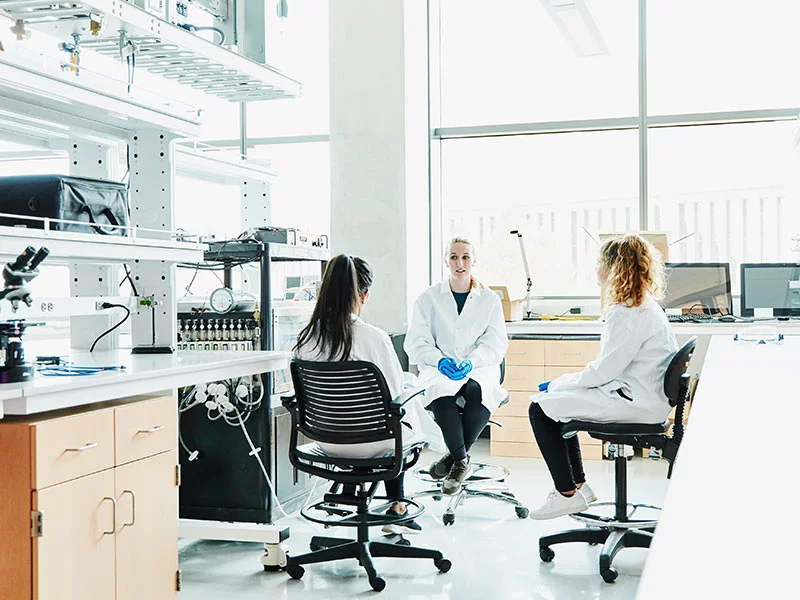
Life sciences technology and innovation are moving at breakneck speed. Meanwhile, workforce preferences have evolved more in the past few years than in the previous two decades. To compete, biopharmaceutical companies must not only use capital efficiently and operate with agility but also provide inspiring workplaces that attract and retain talent. Wherever your organization is in its growth trajectory, your facilities can support your talent and business strategies— if you’re armed with the right data.
Real estate and facilities professionals have historically relied on traditional data points to analyze life sciences space performance, including square footage per person, floor load capacity, column spans, filtration and ventilation, and even proximity to other research institutions. Now, outdated real estate metrics must be replaced with custom data that is meaningful for your unique culture, talent strategy and operating goals.
Data-driven insights with an eye on the future can help you align your real estate and facilities with your business vision, strategy and talent needs, while also demonstrating how corporate real estate contributes to the overall success of the business and its stakeholders.
Human experience drives real estate performance
Traditionally, most companies have been hyper-focused on workplace operating costs. While costs are important, the competition for life sciences talent and the high price of turnover makes the value of employee experience just as critical.
Your organization may already be transforming its real estate for a hybrid workforce that elevates the experience and prioritizes mental health and well-being. It's possible to measure those factors with data points and outcomes reflecting staff retention, employee health, quality of the indoor environment, access to green spaces, wellness initiatives, choice and flexibility of workspaces and other components.
In the era of hybrid work, one important area to track is how space is used. Traditional metrics—such as square feet of space per individual desk—no longer apply when only some employees are in the office at any given time, especially if your organization is adopting shared desks.
Understanding whether and how employees use individual desks, collaboration benches, meeting rooms or other workspaces will allow you to make investments in the things most valued by employees. JLL research shows that workplace utilization can be tied to employee satisfaction, retention and efficiency. That is, understanding employee work patterns and investing in the right workplace elements generates a high return in the form of employee experience.
Human experience factors metrics to explore:
How satisfied are employees with their workplace experience?
How many employees are in the office each day of the week?
Which workspaces are employees using the most, and when?
Which workspaces are used the least?
What percentage of workers come to the office for individual versus group activities? What brings them to your workplaces?
How do workplace factors—including quality of the office or laboratory environment, location and policies—influence employee attrition?
Future-proofing labs with agility in mind
Traditionally, laboratories were built for a single purpose, with specific infrastructure and equipment requirements. With ever-changing R&D priorities, staying nimble requires an understanding of whether your current laboratories are built for the future.
A new discovery or change in business strategy can create a sudden need for a different kind of laboratory. In addition, some of your laboratories may present physical problems, such as a lack of natural light or poor temperature controls, that lead to employee dissatisfaction.
Modern laboratories, of course, are often designed for flexibility. Such features as retractable electrical cords, technical infrastructure built behind a façade to open floor space, and thick floor slabs in corridors to support heavy equipment can make it easier to flex without the cost and delay of major renovations or relocations.
Operating agility metrics to explore:
What percentage of your technical space can be reconfigured relatively easily for a new research or production purpose?
What percentage of your research or production space can be easily expanded if needed?
To what extent is each technical facility protected against natural disasters and climate change impacts?
How often are operations brought to a halt by environmental factors, such as temperature fluctuations, excessive humidity or poor ventilation?
How much time do researchers spend traveling from the laboratory to an office workspace where they can document their research results?
How many days/months are needed for your organization to launch a new R&D initiative?
Using real-time occupancy data for real estate efficiency
As your biopharmaceutical organization matures, real estate and facilities can accumulate—especially if you’ve had mergers or acquisitions. Rather than becoming a drag on overall business performance, your real estate and facilities can be used to advance your business vision and goals.
For example, with hybrid working, you may need only a fraction of the office space you currently hold. Laboratory or production spaces may be inefficient or poorly located for talent recruitment purposes, or not as close to customers as you would prefer.
By analyzing occupancy data generated by building technologies, and combining it with business growth projections, you’ll be able to make accurate forecasts about the space you need and avoid waste. Wireless sensors can generate data about when and where employees are using your workplaces, allowing you to make data-driven decisions about efficient workplace layouts.
Utilization levels can be especially helpful in pursuing workspace strategies for life science companies. For example, you may determine that you should relocate or consolidate administrative spaces to back-office areas to free up square footage for R&D.
You also can use data and analytics tools to evaluate your real estate portfolio holistically on the basis of productivity, flexibility, costs, talent recruitment and retention and other factors. Today’s facility and workplace technologies make it possible to capture and analyze a wide range of corporate real estate data and integrate it with business data to drive portfolio decisions.
Corporate real estate efficiency metrics to explore:
What is our total corporate real estate cost per person?
What is our real-time space utilization?
How accurate is our capital planning?
Which of our facilities operate most efficiently and sustainably?
Managing by the numbers
Seismic change in the biopharmaceutical sector—including its offices and laboratory modes of working— has sharpened C-suite focus on real estate and facilities as never before. Many organizations are considering how real estate can do more than serve as a backdrop for productivity, and instead become a driver of business value.
Your biopharmaceutical enterprise leaders can work across department lines to reimagine portfolio strategy by tracking innovative metrics to optimize the value of the organization’s facilities. After all, what is managed should be measured—and that’s one more reason why metrics matter.