Technology labs are becoming critical assets requiring specialized CRE strategies and operational expertise
08 July 2026
Insight
08 July 2026
Preparing technology labs for next-generation innovation
Categories:
Authors
Jana Cheong
Kamya Miglani
Vidhi Sharma
Amber Schiada
Key highlights
- Technology lab space is becoming a critical component of CRE portfolios in the age of AI: As companies expand technology lab facilities with accelerating AI investments, they are prioritizing utilization tracking to optimize space allocation and efficiency in these complex environments.
- Different technology lab types require tailored infrastructure approaches: AI/ML, hardware & equipment, semiconductor design R&D, quantum computing, and game development labs each have unique infrastructure and environmental control requirements that shape facility design and operational strategies.
- CRE teams need to plan for and manage the technology lab of the future: Next-generation labs will see increased automation and robotics, AI-driven monitoring solutions, and hybrid lab-office spaces enabling cross-functional collaboration.
Technology labs are critical real estate in the AI era
The AI market is projected to maintain strong growth, driven by the continued enterprise adoption of AI as organizations race to keep up with their peers. Technology organizations are investing heavily in specialized lab infrastructure to support R&D activities and secure competitive advantages amid the AI boom.
Technology lab spaces now account for 13.9 million square feet within JLL's Occupancy Planning & Management portfolio, representing 13% of total managed area, according to the JLL Global Occupancy Planning Benchmark Report 2026. This substantial footprint reflects how central lab infrastructure has become to corporate strategies.
Participation in technical space utilization tracking has jumped from 5% to 26% year-over-year across industries, according to the same JLL report. Technology companies are ahead of the average, at 32%, signaling growing organizational commitment to maximizing efficiency in these complex spaces.
To support the rapid AI buildout, technology lab spaces have become a high priority as companies expand their R&D footprint. However, strategies around technology lab spaces currently lag the speed of business imperatives. Better planning and management of next-generation technical facilities requires deeper understanding of the variety of lab activities and their operational requirements.
Five technology lab types with distinct space requirements
Technology labs span diverse R&D activities, each with fundamentally different operational characteristics and space requirements. Understanding these distinctions is essential for effective portfolio planning and facility management strategy. Five major technology lab types have been identified, ranging from computational AI development to physical hardware prototyping.
Unlike traditional office space where standardized requirements allow for relatively uniform facility specifications, technology labs demand tailored approaches. For instance, a quantum computing facility requires cryogenic infrastructure that would be unnecessary in the other types of labs. This specialization extends beyond physical infrastructure. Each lab type operates on different refresh cycles that directly impact capital planning. AI & ML labs face compressed compute hardware refresh cycles of 2-3 years, driven by rapid AI model architecture shifts. To account for this, spaces need to be flexibly designed with capacity headroom to accommodate future hardware densities. In contrast, quantum computing infrastructure is designed for long service life with high upfront costs and lengthy lead times. The deep integration into building structure creates significant lock-in risk, as modifications to quantum architectures post-installation are extremely costly.
Hardware labs, semiconductor design facilities, and game development studios fall somewhere within this spectrum. While their computational hardware follows short refresh cycles, specialized physical infrastructure such as cleanrooms and environmental chambers represents long-term capital commitments that constrain future modifications. Establishing robust network capabilities upfront is also essential for labs relying on compute functions, helping organizations mitigate long-term operational risks.
Understanding operational requirements of technology lab spaces is key to space optimization
Despite technology labs representing significant capital investments, utilization tracking in these environments lags office space monitoring. JLL data shows 91% of surveyed technology companies track utilization data for office spaces, but only 32% track utilization rates in their technical spaces.
This gap has meaningful consequences. Without visibility into how these spaces are actually used, companies cannot accurately identify capacity constraints, underutilized areas, or reconfiguration opportunities that would improve productivity. Technology organizations point to identifying underutilized space and understanding efficient space usage as the key technical space planning challenges that would deliver the most operational impact if solved, according to JLL's Global Occupancy Planning Benchmarking Report 2026.
The challenge of utilization runs deeper than tracking the space itself. Unlike in office environments, technical spaces are equipment-centric. Effective utilization tracking requires visibility into both physical space usage and critical assets such as IT racks and workstations, yet only 17% of surveyed technology organizations currently monitor these, according to JLL's Global Occupancy Planning Benchmarking Report 2026.
This visibility gap is particularly consequential given rising energy demands. Power-intensive facilities like AI training labs and quantum computing centers consume enormous energy. Monitoring assets would not only allow organizations to improve operational efficiency but also optimize energy performance and reduce both cost and carbon footprint.
Achieving this level of oversight requires sophisticated space management capabilities. For example, cleanrooms require stringent contamination control protocols while quantum computing facilities need continuous cryogenic system monitoring. Any environmental deviation can compromise expensive work processes or damage sensitive equipment. Without proper tracking systems, facility teams operate reactively rather than proactively, addressing problems only after they impact operations.
Preparing for the technology lab of the future
Next-generation technology labs will increasingly integrate automation, robotics, and AI-driven monitoring systems while blurring traditional boundaries between laboratory and office environments. CRE teams must prepare for these shifts to avoid costly retrofits and operational disruptions.
Automation and robotics integration
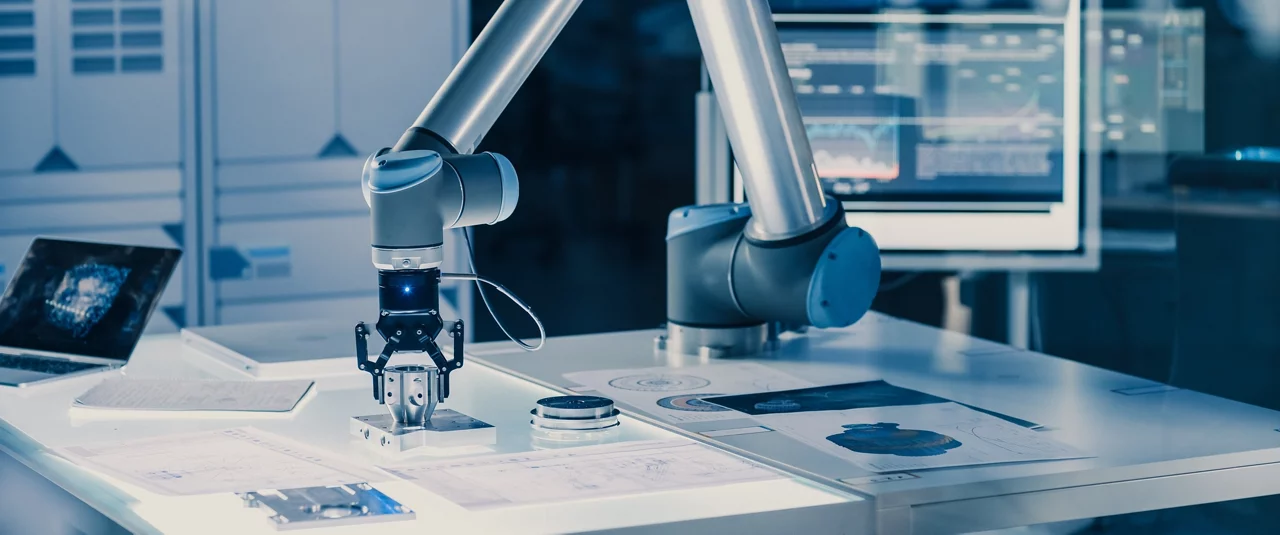
The integration of automation and robotics is transforming technology laboratory design, requiring infrastructure that can adapt to rapidly evolving requirements without committing excessive capital to unused capacity. Robots increasingly work alongside human researchers, from collaborative robotic arms performing device testing to automated material handling systems in semiconductor fabrication. These systems likely require larger equipment footprints, different operational clearances, and serviceable access envelopes. Designing for maintenance access from the start prevents costly facility management remediation and ensures continuous operations.
To maintain agility in infrastructure planning, it is worth considering a micro-modular design approach. Minimal core infrastructure, paired with plug-and-play modular elements, enables equipment swap-outs as technology evolves and can accommodate shifts in lab focus without costly hard fit-out replacements.
Hybrid lab-office environments
Strategic integration of research labs, offices, and support spaces drives innovation through enhanced collaboration, requiring organizations to blur traditional boundaries through adjacencies that enable spontaneous inter-organizational interaction.
Looking at game development studios: Office-based creative teams positioned near motion capture stages and playtesting labs can collaborate easily with technical staff, accelerating iteration cycles and improving product quality. Similarly, collaborative innovation is unlocked when design teams, testing facilities, and analytical labs occupy adjacent zones.
Innovation hubs positioned between labs and offices provide environments for integrating collaborative office functions with technical work. The Shanghai World Laureates AI Lab in China exemplifies this approach, featuring an ecosystem that integrates research labs, data centers, and collaboration spaces designed to break down silos and encourage cross-disciplinary interaction.
AI-powered monitoring systems
Technology labs such as AI/ML and quantum computing facilities generate extreme heat loads requiring constant cooling to prevent equipment overheating and costly downtime. Traditional cooling systems operate at fixed capacity regardless of actual demand, consuming substantial energy. An AI-driven monitoring solution can simultaneously save energy and support operational uptime with dynamic cooling based on actual thermal loads, significantly reducing energy consumption. These same sensor data feeds predictive analytics that flag operational anomalies before they escalate into failures, maintaining continuous uptime.
As labs face intensive energy demands and critical uptime requirements, this dual-benefit approach has rapidly gained importance. The adoption is already underway; JLL's Global State of Facilities Management 2025 reports that 46% of large companies have already integrated AI into facility management operations.
Strategic imperatives for CRE teams managing technology labs
Technology labs house specialized infrastructure critical to innovation and competitive advantage. CRE teams must evolve from traditional space planning to technical space and asset management, understanding the operational distinctions between different lab types and translating those distinctions into infrastructure specifications and facility management strategies.
To position CRE teams to lead critical environment management requires investment in both human capital and operational processes as space requirements intensify.
What CRE teams can do to prepare:
Want to learn more?
Get in touch with us to find out how we can support your real estate strategy with market insights and strategic advice.

Dirk Raket
Managing Director – Accounts Management
Justin Kenyon
Managing Director, Technology
John Leddy
Managing Director - Technology