More floating solar projects are emerging across the country
07 April 2024
Guide
07 April 2024
Can floating solar replicate its Asian success in America?
Categories:
Authors
Bryan Thomas
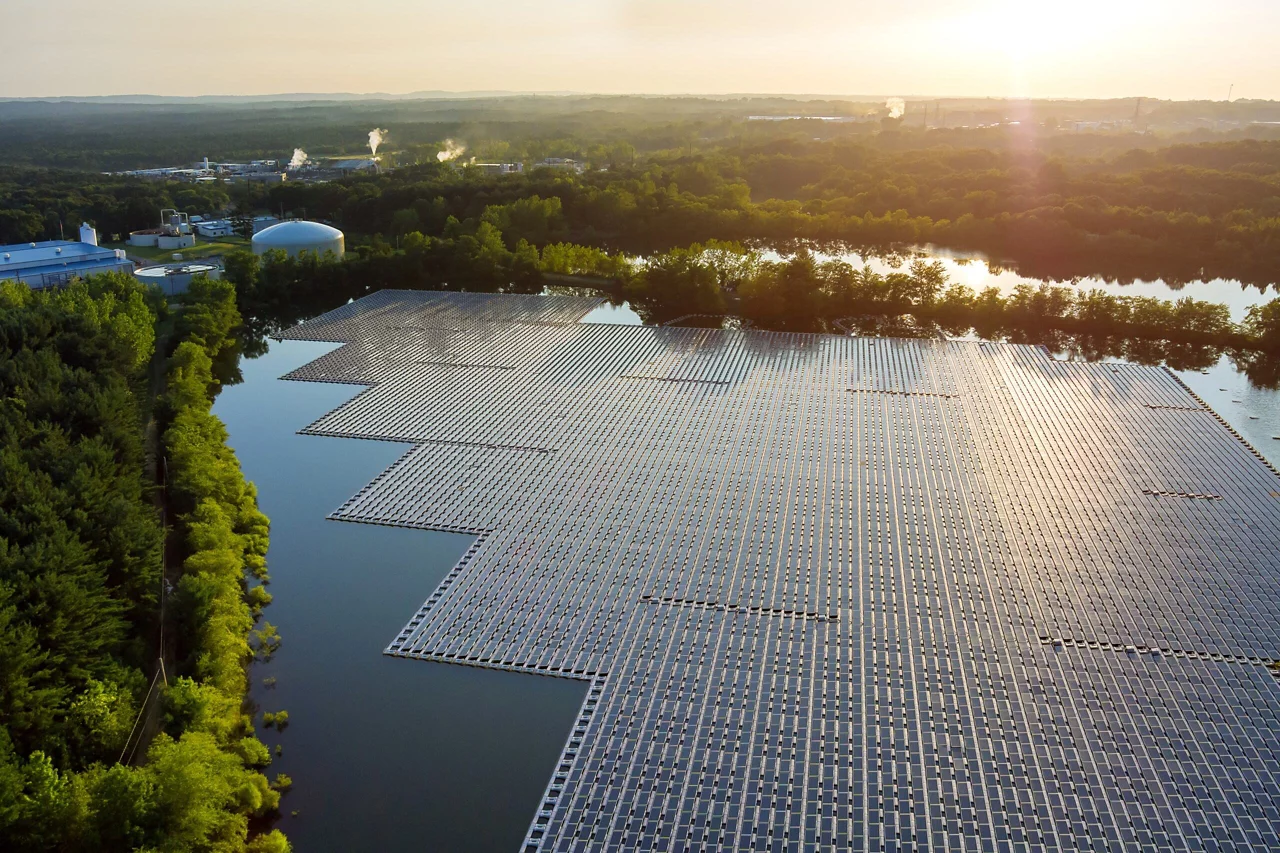
Floating solar is already booming in Asia where land is in short supply and prices are high. Now it’s making inroads in the U.S. as demand for renewable energy continues to soar.
More reservoirs, stormwater basins, dams and even lakes are playing host to solar panels attached to rafts to form a floating layer strategically positioned on top of the water line.
New Jersey is currently home to the country’s biggest floating solar project, consisting of 16,510 panels generating 8.9MW of power. Over in Healdsburg, California, another floating solar farm produces 4.8 MW - enough to power more than 3,000 homes.
Elsewhere, the Department of Defense unveiled its first 1.1MW floating solar system at Camp Mackall, a Special Forces training site in North Carolina, in 2022. The panels will be the main power source for the site during outages from storms, as well as cutting energy costs by an estimated $100,000 a year.
These projects show the growing potential of floating solar for U.S. water districts, producing clean energy without taking up land that could be used for agriculture or other development.
While they can’t match the output of many land-based projects – the largest U.S. project being the 875MW Edwards Sanborn in California’s Mojave Desert – floating solar has numerous plus points. As the water keeps panels cool, they’re able to generate more electricity than land-based panels which work less efficiently when they overheat.
There are cost benefits too. Compared to ground mount systems, floating solar also has reduced operation and maintenance costs, with no vegetation management activities required. Under a third-party owned system, developers can expect to pay less for lease or licensing costs.
Water conservation is another advantage. Large scale rafts of floating panels can effectively seal the surface of the water to reduce evaporation. This is a particular benefit for drought-afflicted areas like California. In fact, a 2023 study published in the journal Nature found that covering 30% of the surface of the world’s 115,000 reservoirs with solar panels would not only meet the energy needs of more than 6,000 cities across 124 countries but it would save enough water to fill 40 million Olympic-sized swimming pools each year.
Finally, floating solar can be easier for local communities to accept. One of the big criticisms of land-based solar is that it’s an eyesore or taking up too much space. For water districts in particular, adding panels to reservoirs and retention ponds can be a more palatable alternative as the race to decarbonize picks up pace.
Floating solar challenges
Installing floating solar, however, isn’t as simple as putting panels on roofs. Not all bodies of water are suitable; fast moving water, open ocean or shorelines with big waves are all out. Cost is another issue. Floating solar projects are around 10% to 15% more expensive to set up than equivalent on land installations.
Deep water, too, poses additional challenges for how the rafts are ballasted while changing water levels and annual drainage to keep some water facilities in optimal condition can also impact performance.
The location of interconnection points where power is delivered to the electrical grid is another consideration. In less urban areas where a site host is unable to consume some or all the solar power, grid interconnection points can be a fair distance from the floating solar site, adding to project costs. Fortunately, for water districts with wastewater operations adjacent or close to the floating solar, the required infrastructure is usually already in place with interconnection point nearby.
Yet once solar farms are up and running, the energy produced can power owned real estate or even be sold to the grid to provide a regular income stream – depending on what’s allowed under local rules.
A bright future
The U.S. floating solar panels market is still in its infancy, valued at $35.4 billion in 2022, according to SNS Insider.
In comparison, Asia Pacific hosted around 90% of floating solar, equating to 3GW, in 2022. The 320MW Dezhou Ding Zhuang Floating Solar Farm in Shandong, China is currently the largest in the world – but not for much longer. An even bigger project from Blueleaf Energy and SunAsia Energy in the Philippines is on the cards.
In the U.S., momentum is also picking up. Growth is forecast at a compound annual growth rate of 22.6% to reach over $180 billion by 2030.
Solar installation incentives and rebates at all levels are helping to make projects an attractive investment amid rising demand for clean energy across the public and private sector. The Federal government is offering tax credits through the Inflation Reduction Act while states such as New Jersey and New York have implemented their own incentive programs.
While floating solar will never compete against land-based solar in terms of output or scale, new innovations are helping. Renewable energy solution provider SDN recently unveiled new 600W solar modules designed specifically for floating installations.
Such developments underline the opportunity floating solar provides in maximizing the use of existing water-based assets to generate the increasing amounts of clean energy required.
Well-designed and well-managed projects can be a solid investment for owners to reduce their own energy costs and potentially open additional revenue avenues while playing their part in creating a more sustainable future.
To find out more about how you could integrate floating solar into your real estate, talk to our Sustainable Infrastructure team.
Contact: Bryan.Thomas@jll.com